Chapter III
From Deep Voting to Network-Source AI
Chapter Summary
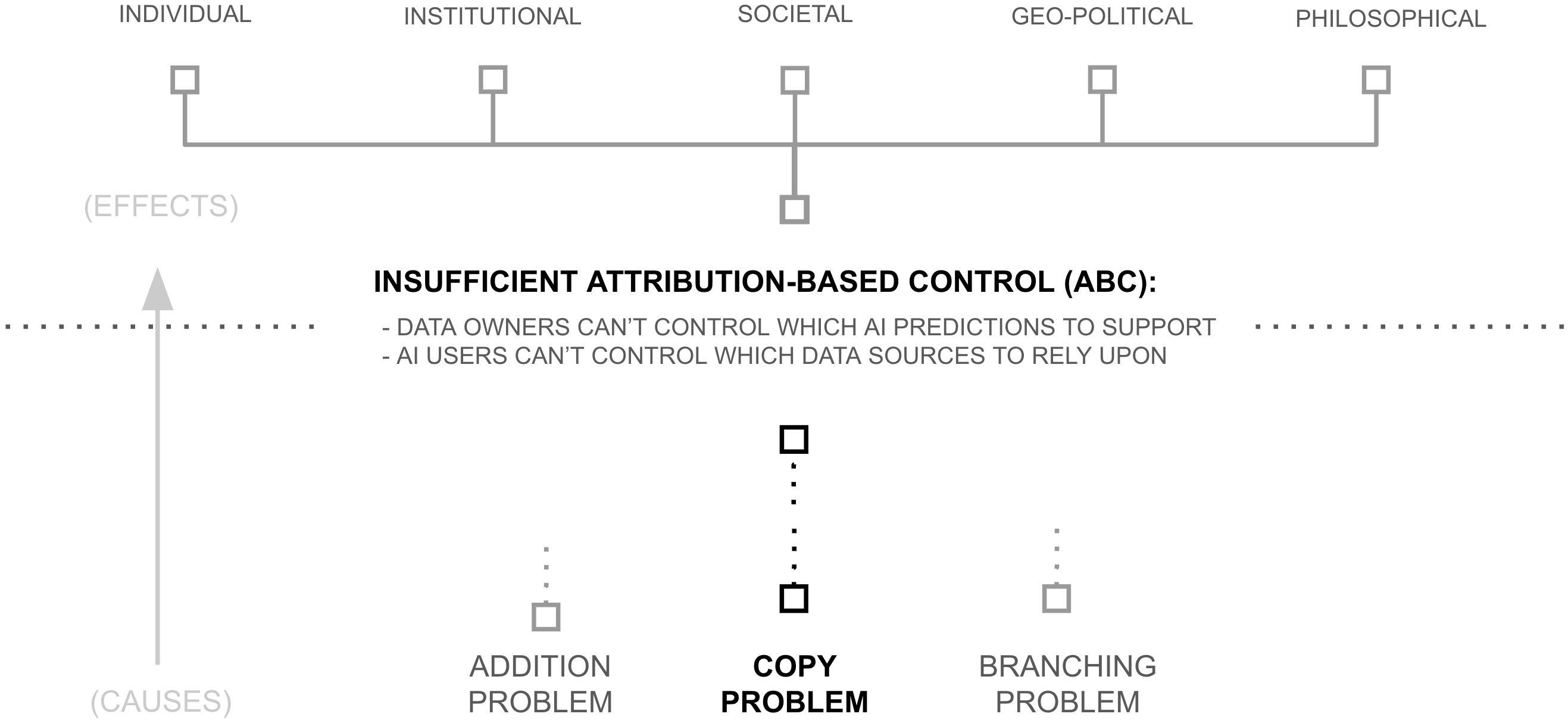
The previous chapter outlined how the offsetting of addition with concatenation in deep learning systems can lead to source-partitioned knowledge in AI systems, unlocking a viable path towards the attribution needed for ABC: deep voting. However, deep voting does not offer attribution based control. It only offers attribution-based suggestions which the holder of an AI model may ignore. This chapter unpacks the underlying cause of voluntary participation in both open-source and closed-source AI. It begins by describing how ABC is thwarted by the only control paradigm of AI systems, unilateral control: that whomever obtains a copy of information can unilaterally use that information for any purpose. This suggests a direction for a solution: to reduce the copying of information within AI systems, averting unilateral control. Building upon this diagnosis, the chapter calls upon the framework of structured transparency (Trask et al., 2020) to avert the copy problem, revealing a new alternative to open-source and closed-source AI: network-source AI — and a viable path towards true attribution-based control in AI systems.
The Problem of ABC in Deep Voting Systems
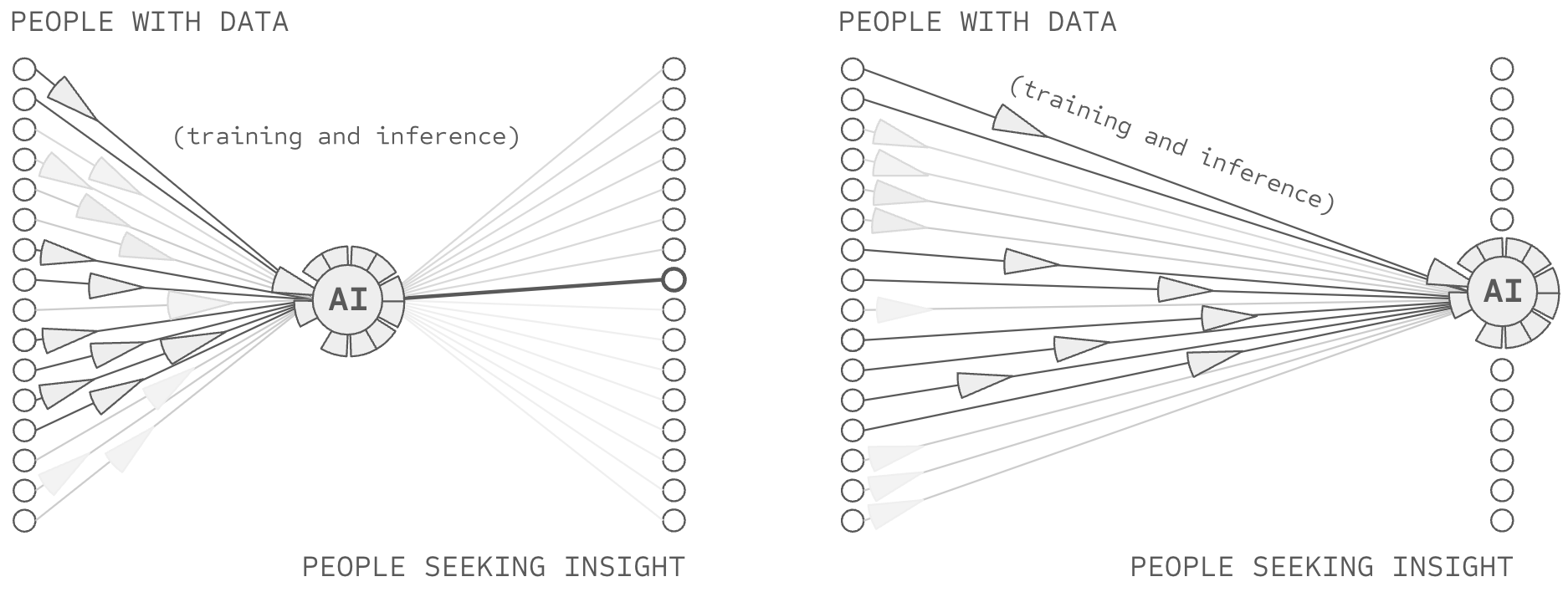
The previous chapter offered a vision to unlock 6+ orders of magnitude more data and compute for AI training through deep voting. By maintaining clear attribution through retrieval mechanisms while enabling efficient parameter sharing for general patterns, deep voting architectures offer a theoretical framework for safe data sharing across institutional boundaries. Yet a fundamental problem threatens to undermine its vision. Even with perfect implementation of intelligence budgets and attribution guarantees, deep voting alone cannot ensure true attribution-based control.
The reason is structural: a deep voting model, (like any AI system today) is unilaterally controlled by whomever possesses a copy. For ABC to occur, the owner of an AI model would have to voluntarily choose to uphold the wishes of data sources (i.e. respect and enforce privacy budgets calcuated by deep voting algorithms). Deep voting’s careful attribution mechanisms are not a system of control, they are mere suggestions to give credit to data sources for predictions.
A Library Analogy
Consider a bookstore which purchases books once but then allows customers to come in and print copies of the books for sale in their store (without tracking how many copies people make). Naturally, authors of books might be hesitant to sell their books to the store because they presumably make far less money than if they sell to a store which does not enable copies.
This book store analogy corresponds closely to the current practice of deep learning models, which offer unmeasured, unrestricted copying of information due to their inability to offer attribution with their predictions. Fortunately, deep voting offers a way for attribution metadata to be revealed and configured, but does this solve the issue?
Not necessarily, because of an inherent information asymmetry: in a bookstore where the bookstore owner knows how many copies are made, the bookstore owner has far more information on whether their clientele are likely to purchase copies of the book than the author of the book does. Thus, even if the author tries to raise their prices to make up for the bookstore making copies, the original author still struggles to know what the true price might be relative to the bookstore owner.
Instead, to maximize incentives for the authors of books (and maximize the number of books being offered in stores), authors should instead be able to sell their books one copy at a time. In this way, the author can set their price and will make more money if more books are sold. Not only will this better motivate authors to sell their books in more stores, but it will also serve to attract more people to become book authors.
First Why: Unilateral Control Averts A-Based Control
This unilateral control problem reflects a deeper pattern that has constrained information systems throughout history. When one party gives information to another, the giver loses control over how that information will be used. AI systems, despite their sophistication, remain bound by this same fundamental limitation. Organizations sharing their data with an AI system have no technical mechanism to enforce their attribution preferences; they must simply trust the model’s operator to honor them
Consider how this manifests in practice. A deep voting model might faithfully track attribution and maintain intelligence budgets, but these mechanisms remain under unilateral control. The model’s owner can simply choose to ignore or override these constraints at will.
This creates a trust barrier that blocks deep voting’s potential. Medical institutions, for example, cite exactly these control and attribution concerns as primary barriers to sharing their vast repositories of valuable data (Youssef et al., 2023). Without a way to technically enforce how their information will be used and attributed, they cannot safely contribute to AI training. This pattern repeats across domains, from scientific research (Fecher et al., 2015; Ascoli 2015) to financial data (Sienkiewicz 2025) to government records (Scott and Gong 2021); vast stores of valuable information remain siloed because we lack mechanisms to ensure attribution-based control, and the corresponding incentives for collaboration that ABC would bring to AI systems
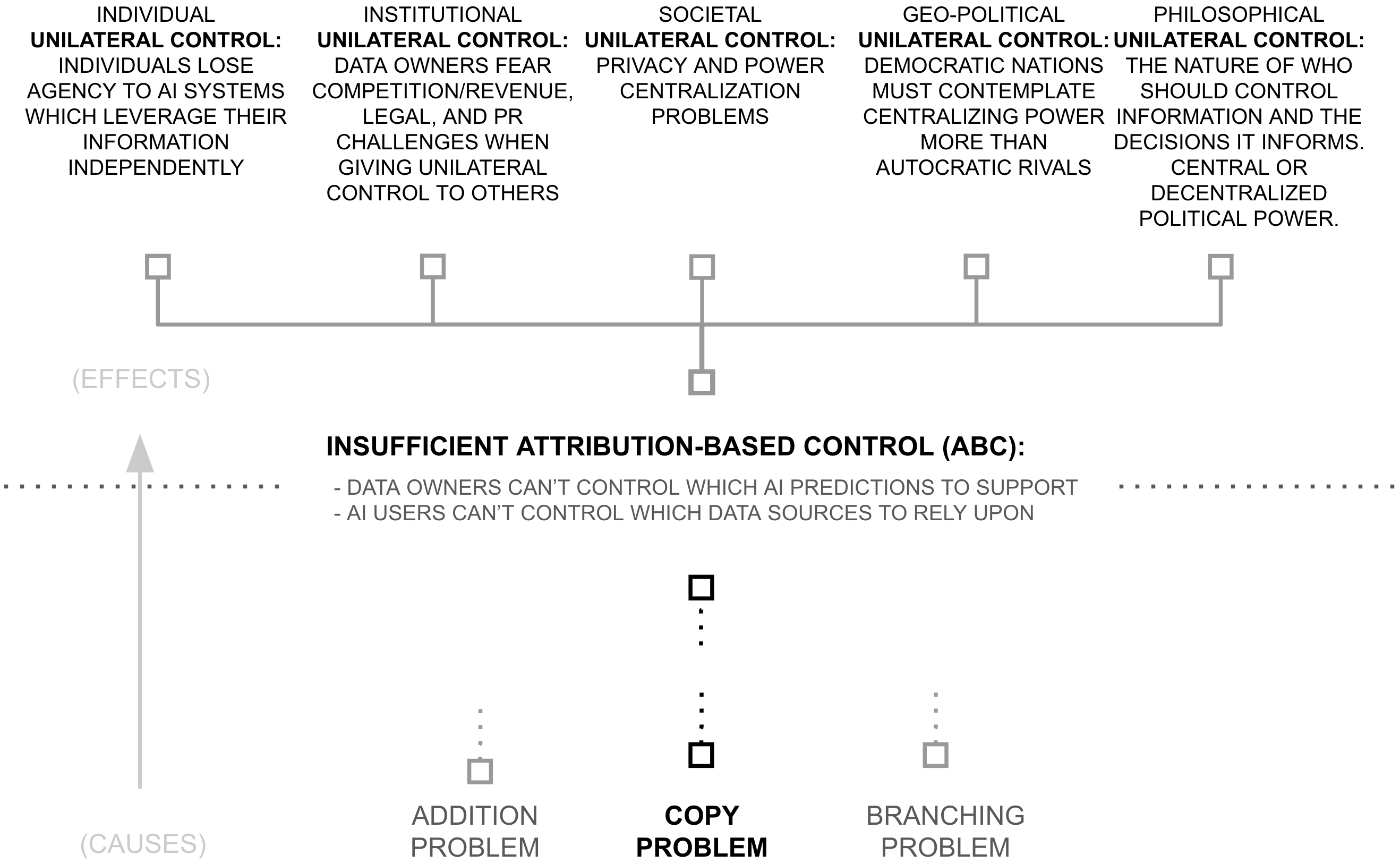
The challenge before us is clear: we need more than just better attribution mechanisms; we need a fundamentally new approach to how AI systems are controlled. We need techniques that transcend the limitations of unilateral control that have constrained information systems throughout history. The next sections examine why current approaches fundamentally fail to solve this problem, and introduce a new paradigm that could deliver on deep voting’s promise.
Second Why: Open/Closed-Source AI Use Unilateral Control
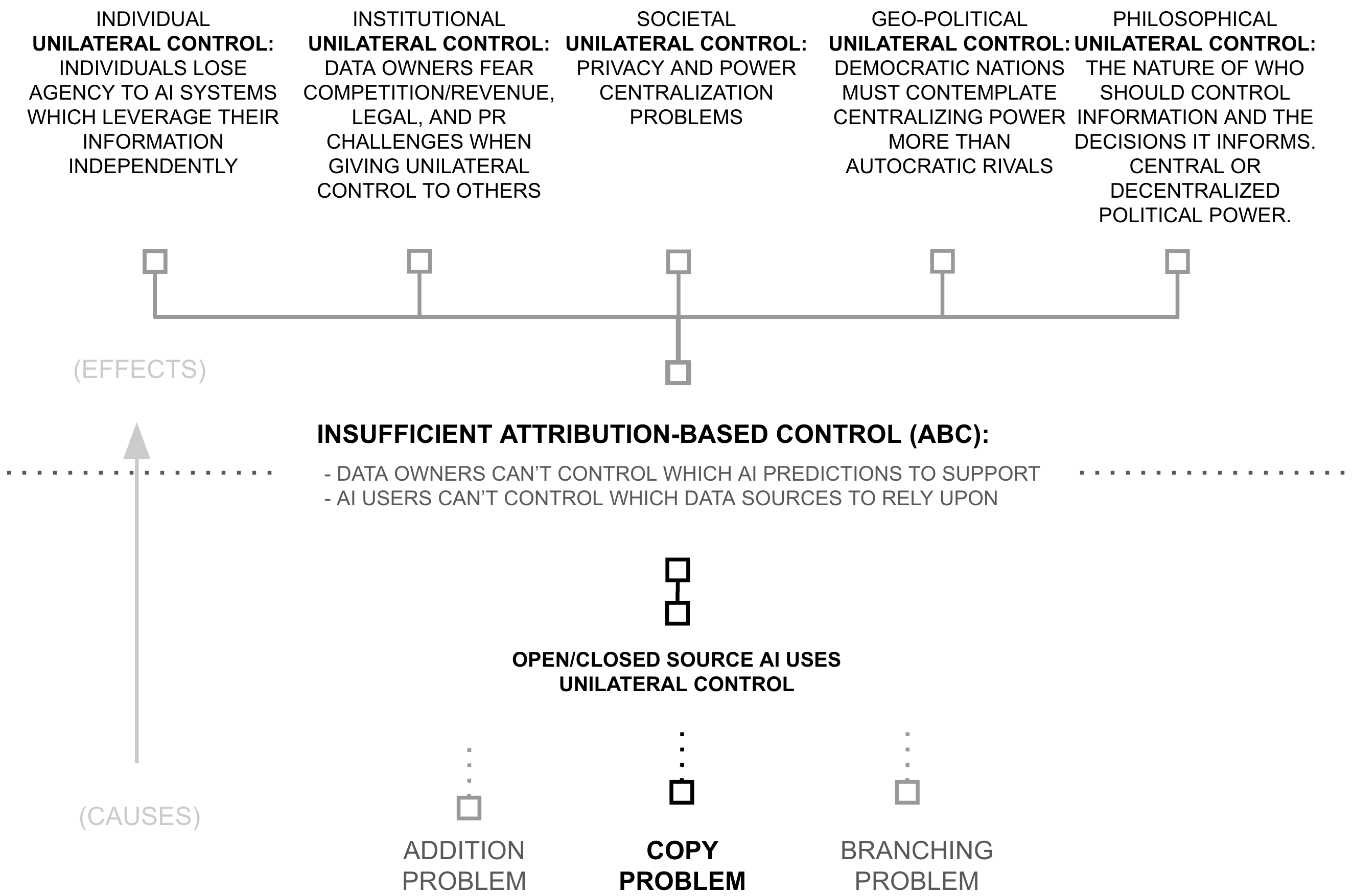
The debate between open and closed source AI crystallizes how society grapples with fundamental questions of control over artificial intelligence (Vidal 2024). This debate has become a proxy for broader concerns about privacy, disinformation, copyright, safety, bias, and alignment (National Telecommunications and Information Administration 2024). Yet when examined through the lens of attribution-based control (ABC), both approaches fundamentally fail to address these concerns, though they fail in opposite and illuminating ways. Consider how each paradigm attempts to address these critical issues:
Copyright and Intellectual Property: The closed source approach could better respect IP rights through licensing and usage restrictions negotiated between formal AI companies and data sources (Associated Press 2025). Open source suggests that unrestricted sharing better serves creators by enabling innovation and creativity (Open Source Initiative 2024). Yet through ABC’s lens, neither addresses creators’ fundamental need to control how their work informs AI outputs. Closed source consolidates control under corporate management, while open source eliminates control entirely.
Safety and Misuse Prevention: Closed source proponents claim centralized oversight prevents harmful applications (Owen-Jackson 2024). Open source advocates argue that collective scrutiny better identifies risks (Grow 2025). Yet ABC reveals that both approaches fail to provide
what’s actually needed: the ability for contributors to withdraw support when their data enables harmful outcomes. Closed source requires trust in corporate judgment, while open source enables unrestricted modification of safety measures.
Bias and Representation: Closed source teams promise careful curation to prevent bias (Gabriel et al., 2024). Open source suggests community oversight ensures fair representation (Wealand 2025). Yet ABC shows how both approaches fail to give communities ongoing control over how their perspectives inform AI decisions. Closed source centralizes these choices under corporate teams (Pasquale 2015), while open source allows anyone to modify how perspectives are weighted.
This pattern reveals why neither approach can deliver true attribution-based control. Consider first the closed source approach. Proponents argue that centralized control ensures responsible development and deployment of AI systems. A company operating a closed source model can implement deep voting’s attribution mechanisms and maintain them intact. Yet this merely transforms ABC into corporate benevolence (exactly the kind of centralized control that has already failed to unlock the world’s data and compute resources). Medical institutions withhold valuable research data (Kaissis et al., 2020; Gould 2015), publishers restrict access to their work (Grynbaum and Mac 2023) precisely because they reject this model of centralized corporate control. The very centralization that supposedly enables control actually undermines it, replacing genuine ABC with a hope that power will be used wisely.
The open source approach appears to solve this by eliminating centralized control entirely. If anyone can inspect and modify the code, surely this enables true collective control? Yet this intuition breaks down precisely because of unrestricted copying. Once a model is open sourced, anyone can modify it to bypass attribution tracking entirely. The same problems that plague closed source systems (hallucination, disinformation, misuse of data, etc.) remain hard to address when control is abdicated to any AI user. Open source trades one form of unilateral control for another (from centralized corporate control to uncontrolled proliferation). But ABC requires a collective bargaining between data sources and AI users, not total ownership by either (or by an AI creator).
This reveals a deeper issue: our current paradigms of software distribution make true ABC impossible by design. Open source sacrifices control for transparency, while closed source sacrifices transparency for control. Neither approach can provide both. Yet ABC requires exactly this combination: transparent verification that attribution mechanisms are working as intended, while ensuring those mechanisms cannot be bypassed.
The AI community has largely accepted this dichotomy as inevitable, debating the relative merits of open versus closed source as though these were our only options. But what if this frame is fundamentally wrong? What if the very premise that AI systems must exist as copyable software is the root of our problem? The next section examines this possibility, revealing why the copy problem itself may be what we need to solve.
Third Why: Copy Problem Necessitates Unilateral Control
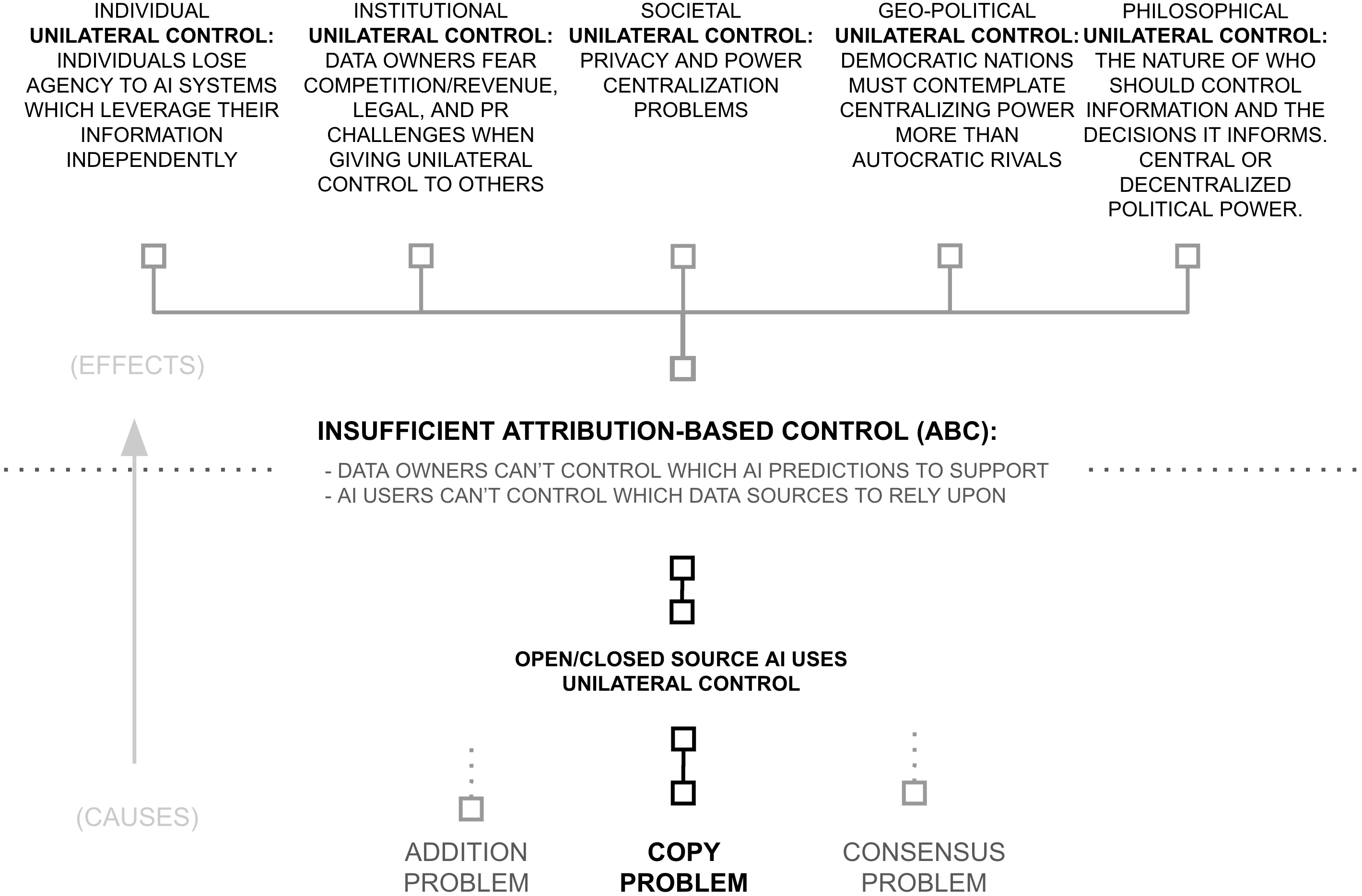
The previous section demonstrated that both open and closed source paradigms fail to enable attribution-based control. This failure reflects a more fundamental limitation: control over information is lost when that information exists as a copy. This ”copy problem” manifests acutely in AI systems. When a model is trained, it creates a derived representation of information from its training data encoded in model weights. These weights can then be replicated and modified by whoever possesses them, with the following consequences:
Closed Source Models: Even with perfect attribution tracking and intelligence budgets, these mechanisms remain under unilateral control of the model owner. Data contributors must trust that their attribution preferences will be honored, lacking technical enforcement mechanisms.
Open Source Models: Once a model is released, anyone can replicate and modify it to bypass attribution mechanisms entirely. Public distribution necessarily surrenders control over use.
Both approaches treat AI models as copyable software artifacts, rendering attribution-based control infeasible. Once a copy exists, technical enforcement of attribution becomes impossible.
This limitation extends beyond AI. The music industry’s struggles with digital piracy (Cummings 2017), society’s challenges with viral misinformation (Shu et al., 2020), and government efforts to control classified information (Elsea 2006) share the same fundamental issue: information, once copied, escapes control (Schneier 2015; Veliz 2020).
This analysis reveals why current approaches to AI governance are fundamentally insufficient. Attribution tracking, usage restrictions, and oversight mechanisms cannot solve the problem while AI systems exist as copyable artifacts. The architecture of AI distribution and operation itself prevents attribution-based control.
Consequently, if AI systems remain copyable software, we cannot ensure proper source attribution, prevent data misuse, motivate a new class of data owners to participate in training, or maintain democratic control over increasingly powerful systems
This limitation necessitates a fundamentally different approach. Rather than choosing between open and closed source (different modes of copying and controlling software) we must reconsider how AI systems are distributed and operated. The following sections introduce such an approach.
Third Hypothesis: From Copying to Structured Transparency
The copy problem reveals that our current approaches to AI control are fundamentally flawed because the current approaches to information control in general are fundamentally flawed. Yet, the copy problem naturally suggests a direction: don’t copy information.
Yet, what would this mean practically in the context of AI? Could a deep voting system be constructed wherein the various data sources never revealed a copy of their information to each other (or to AI users)? Might it be possible for them to collaborate without copying (to produce AI predictions using deep voting’s algorithms) but without anyone obtaining any copies of information they didn’t already have during the process (except of course the AI user receiving their prediction)? Indeed, this might be the case. Let us begin by introducing design patterns which could make this possible.
Semi-input Privacy: Federated Computation
To begin, we call upon the concept of semi-input privacy, which enables multiple parties to jointly compute a function together where at least some of the parties don’t have to reveal their data to each other. Perhaps the most famous semi-input privacy technique is on-device/federated learning (McMahan et al., 2017), wherein a computation moves to the data instead of the data being centralized for computation.
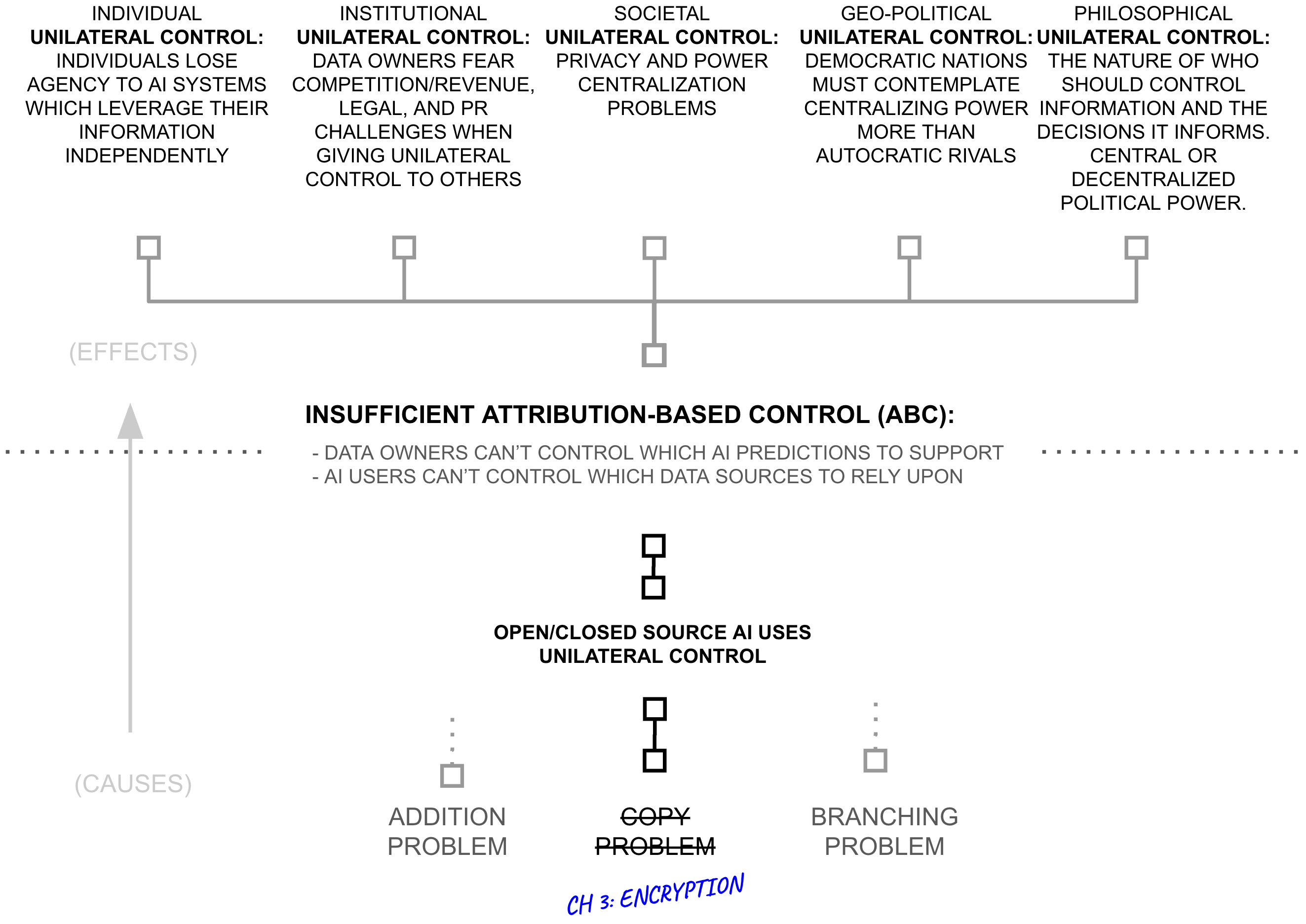
Deep voting could leverage federated computation (Kaissis et al., 2020) to allow data sources to train their respective section of an AI model without sharing raw data. More specifically, recall that a deep voting architecture partitions an AI model’s weights into source-specific sections, which are merged through either semantic (e.g., RAG) or semantic (e.g., model merging) means. In theory, instead of each of these partitions being created and/or stored by the AI user or singular model owner, each data source (i.e. Reddit, the New York Times, and other data sources) could run a web server they control, and create and store their part of a deep voting model on that server.
In this way, whenever and AI user wanted to use a deep voting model, they would need to ping the corresponding servers, who would view the AI query, create the right semantic query (i.e. RAG query), and send the query results and a syntactic model partition to the AI user for final forward propagation.
In this way, each source could maintain control of their data while still contributing to the overall system. However, semi-input privacy alone proves insufficient. While the raw training data remains private, each data source would see every query being used against the model. Furthermore, the AI user learns a tremendous amount about each data source in each query, receiving not only relevant sematic query results (i.e. RAG results) from each data source, but also their syntactic model partition. This creates two problems: the AI user has to be willing to reveal their queries to many (potentially thousands or even millions) of data sources, and the data sources have to be ok with the risk that (after enough queries) the AI user would probably have a copy of the underlying data and model. Eventually, semi-input privacy violates ABC.
Full Input Privacy: Secure enclaves, homomorphic encryption, etc
To address these limitations, we need full input privacy, where no party sees data they didn’t already have (except the AI user receiving the prediction). This includes protecting both the AI user’s query and the data sources’ information.
A variety of technologies can provide input privacy: secure enclaves, homomorphic encryption, and various other secure multi-party computation algorithms (Gentry and Boneh 2009; Costan and Devadas 2016; Yao 1982a; Goldreich 1987; Bogdanov et al., 2014; Craddocket al., 2018). For ease of exposition, consider a combined use of homomorphic encryption and secure enclaves.
In the context of deep voting, two privacy preserving operations are necessary. First, the AI user needs to privately send their query to millions of sources, who then must reply with relevant semantic information (e.g. RAG results), and relevant syntactic information (e.g. model partitions). For this, an AI user might leverage a homomorphic encryption (Gentry and Boneh 2009; Boneh et al., 2011) key-value database, enabling them to query vast collections of databases without precisely revealing their query.
This brings us to the second privacy preserving operation, the transformation from semantic and syntactic responses into an output prediction. For this, the group might co-leverage a collection of GPU enclaves. GPU enclaves (Costan and Devadas 2016) offer full input privacy by only decrypting information when that information is actively being computed over within its chip, writing only encrypted information to RAM and hard disks throughout its process. Indeed, a GPU enclave enables a collection of data providers to jointly compute a function without even the administrator (or cloud provider) of the GPU enclave knowing what is being computed.
Taken together, while there are a variety of full input privacy technologies, some combination of technologies fit for querying and then computing is likely appropriate for maximizing various performance tradeoffs (Craddock et al., 2018). And when used properly, these technologies could enable deep voting wherein each data source retained sole control over the only copy of their information (semantic and syntactic), and the AI user didn’t need to fully reveal their query to the many data sources they elect to leverage.
Yet, the result of the AI prediction is still revealed to the AI user. What if the AI user asked, ”what is all the data you can see?”. What’s to prevent aforementioned hardware and algorithms from being circumvented by an AI query that just copies out sensitive information? For this, input privacy is not enough.
Output Privacy: Deep Voting's Built-in Guarantees
While input privacy protects data during computation, it doesn’t prevent the AI system’s outputs from revealing sensitive information about the inputs. As just described, consider an AI user who prompts ”what is all the data you can see?” or makes a series of clever queries designed to reconstruct training data. Even with perfect input privacy, the outputs themselves might leak information.
However, deep voting’s intelligence budgets (via differential attribution mechanisms) already provide the necessary output privacy guarantees. This is because differential attribution and differential privacy (Dwork et al., 2006; Dwork et al., 2014) are two sides of the same coin:
- Differential privacy focuses on preventing attribution, ensuring outputs don’t reveal too much about specific inputs
- Differential attribution focuses on ensuring attribution, guaranteeing that outputs properly credit their influences
Both are ways of measuring and providing guarantees over the same fundamental constraint: the degree to which an input source contributes to an output prediction (Dwork et al., 2014). Thus, by enforcing intelligence budgets and attribution bounds, deep voting naturally limits how much information about any source can be leaked through outputs. We don’t need to add additional privacy mechanisms; we simply need to ensure that our input privacy technologies (secure enclaves and homomorphic encryption) properly enforce the attribution bounds and intelligence budgets that deep voting already specifies.
However, this creates a new challenge: with all these privacy protections in place, an AI user is forced to rely upon vast collections of information they cannot see. This should beg the question: how would an AI user know that the information they’re relying upon is real... is something other than random noise? This leads us to our next guarantee: input verification.
Input Verification: Zero-Knowledge Proofs and Attestation
While input and output privacy protect sensitive information, they create a fundamental challenge for AI users: how can they trust information they cannot see? An AI user querying millions of encrypted data sources needs some way to verify that these sources contain real, high-quality information rather than random noise or malicious content.
Input verification addresses this problem through cryptographic techniques like zero-knowledge proofs and attestation chains (Goldwasser et al., 1989; Feige et al., 1988). These allow data sources to prove properties about their data without revealing the data itself. For example:
- A news organization could prove their articles were published on specific dates, because a hash of the data was signed by someone who is a trusted timekeeper
- A scientific journal could prove their papers passed peer review, because the paper was cryptographically signed by the reviewers or journal (e.g. hosted on an HTTPS website).
- A social media platform could prove their content meets certain quality thresholds, because the data is cryptographically signed by a trusted auditor.
- An expert could prove their credentials without revealing their identity (Sovrin; Wang and De Filippi 2020), because the issuer of those credentials has cryptographically signed a statement.
Input verification comes in roughly two styles: internal consistency and external validation. One can think of internal consistency as the type of verification a barkeep might do when inspecting a driver’s license. They might check that the license contains all its requisite parts, that the photos are in the right places, and that the document appears to be untampered and whole.
Meanwhile, external validation is all about reputation, the degree to which others have claimed that a document is true. To continue with the barkeep analogy, this would be like if a bartender called the local government to check that a government document was indeed genuine, ”Hi yes — does the State of Nevada have a person named James Brown with the driver’s license number 23526436?”? The claim is verified not because of an internal property, but because a credible source has claimed that something is true.
Input verification techniques can be used by combining basic public-key cryptography (e.g. signed hashes of data) (Laurie 2014; Chase et al., 2020) with verified computation techniques like zero-knowledge proofs, active security, or secure (GPU or CPU) enclaves (Goldwasser et al., 1989; Loftus and Smart 2011; Costan and Devadas 2016).
For internal consistency, verified computation (Loftus and Smart 2011) enables one to send a function to inspect data and check whether it has properties it should. For example, an AI user who is leveraging MRI scans might send in a classifier to check whether the MRI scans actually contain ”pictures of a human head”, receiving back summary statistics validating that the data they cannot see is, in fact, the right type of data.
In this context, verified computation enables them to know that their function occurred over data (and code) which has particular hashes, so that if they then do a second computation (i.e. an AI prediction), they can use the same verified computation techniques to ensure that the AI prediction is leveraging the same (unseen) data. Taken together, verified computation can enable an AI user to check unseen deep voting partitions for important properties and then ensure those same partitions are used for an AI prediction (all without seeing the partitions directly).
Meanwhile, input verification techniques can also enable the external validation form of verification. As a first step, parties who believe something about a piece of data (i.e. ”According to me... this statement is true”), can use public-key cryptography to hash and sign the underlying data with their cryptographic signature (Laurie 2014; Chase et al., 2020). For example, a journalist might sign their article as being true. A doctor might sign their diagnosis as being their genuine opinion. Or an eye witness to an event might sign their iPhone video as being something they genuinely saw. And if those signed hashes are made available to the AI user, they can then use verified computation to check the hash of the signature against the hash of a piece of data they cannot directly see.
Note that while it might sound far-fetched for everyone to be cryptographically signing all their information, it is noteworthy that every website loadable by HTTPS gets signed by the web server hosting it (Laurie 2014). Thus, there is actually a rather robustly deployed chain of signatures already deployed in the world. For example, if I needed to prove to you that I have a certain amount of money in my bank account, I could load a webpage of my bank, download the page with the signed hash from barclays.co.uk, and show it to you. And the fact that all HTTPS webpages are cryptographically signed by my bank, and the fact that the page would contain my name, address, and bank balance, would be enough for me to prove to you that I possessed a certain amount of money. The generality of this technology being deployed at web scale is one source of optimism around the DID:WEB movement (Wang and De Filippi 2020; Chaum 1985; Adler et al., 2024).
In the context of deep voting, these proofs would be integrated into the input privacy system. When an AI user queries encrypted data sources through homomorphic encryption or secure enclaves, each source would provide not just encrypted data but also cryptographic proofs about that data’s properties. The enclaves would verify these proofs before incorporating the data into computations. And in this way, an AI user can know that they are relying upon information which has properties they desire and which is signed as genuine from sources they elect to trust.
However, this raises another critical question: even if we can verify the inputs, how can we trust that the secure enclaves and homomorphic encryption systems are actually computing what they claim to be computing? Given that no-one can see what happens within these systems (Costan and Devadas 2016), who is to say that they are actually running the program which has been requested by the AI user and data sources? This leads us to our next guarantee: output verification.
Output Verification: Verifiable Computation and Attestation Chains
While input verification ensures the quality of source data, we still need to verify that our privacypreserving computations are computing using the code and inputs that have been requested. Only then can an AI user trust that the aforementioned input/output privacy and input verification techniques are properly enforcing deep voting’s intelligence budgets.
Output verification addresses this through two complementary mechanisms: verifiable computation and attestation chains (Goldwasser et al., 1989; Costan and Devadas 2016). Verifiable computation (Goldwasser et al., 1989; Loftus and Smart 2011) enables parties to prove that specific computations were performed correctly without revealing the private inputs. For deep voting, includes the critical sub-parts of the overal computation:
- Proving that intelligence budgets were properly enforced
- Verifying that semantic (RAG) queries were executed as requested
- Confirming that syntactic model partitions were combined according to specification
- Ensuring that differential privacy guarantees were maintained
Together, these mechanisms allow AI users to verify that their queries were processed correctly while maintaining all privacy guarantees. However, this creates one final challenge: amidst all the parties involved in a deep voting prediction (an AI user, and an unspecified number of data sources), how does one ensure that all the right controls are distributed to all the right parties? This leads us to our final guarantee: flow governance.
Flow Governance: Cryptographic Control Distribution
The means by which the aforementioned algorithms provide control over information is through the distribution of cryptographic keys. Each of these keys gives its owner control over some aspect of computation. The class of algorithm known as secure multi-party computation (SMPC) provides the foundation for this enforcement. Through techniques like additive secret sharing, SMPC enables numbers (and thus any digital computation) to be split into cryptographic ”shares” distributed among participants. Each share-holder gains mathematical veto power over how their share is used in subsequent computations (Shamir 1979).
In the context of deep voting, this enables three critical forms of control distribution:
- Data Control: Each source’s deep voting partition (semantic and syntactic) can be split into shares, with the source maintaining cryptographic control through their share. No computation can proceed without their active participation from shareholders.
- Budget Control: Intelligence budgets become cryptographic constraints enforced through SMPC, rather than just software settings. Each prediction must prove it respects these budgets in sufficient manner for the shareholders (keyholders) to allow the release of the final results to the AI user.
- Computation Control: The process of generating predictions becomes a multi-party computation, with each source maintaining cryptographic veto power over how their information is used.
SMPC can be accomplished through software (e.g., homomorphic encryption) or through hardware (e.g., GPU enclaves) techniques, enabling arbitrary parts of a software program to be blocked based on arbitrary key holders signoff to proceed.
Together, these five guarantees (input privacy, output privacy, input verification, output verification, and flow governance) provide the technical foundation for structured transparency.They enable deep voting to operate without producing copies of information right up until the final result is released to the AI user. However, while these guarantees make controlled collaboration possible, we still need a framework for how AI systems should operate in this new paradigm. The next section introduces network-source AI as this missing piece.
Second Hypothesis: From Open/Closed to Network-Source AI
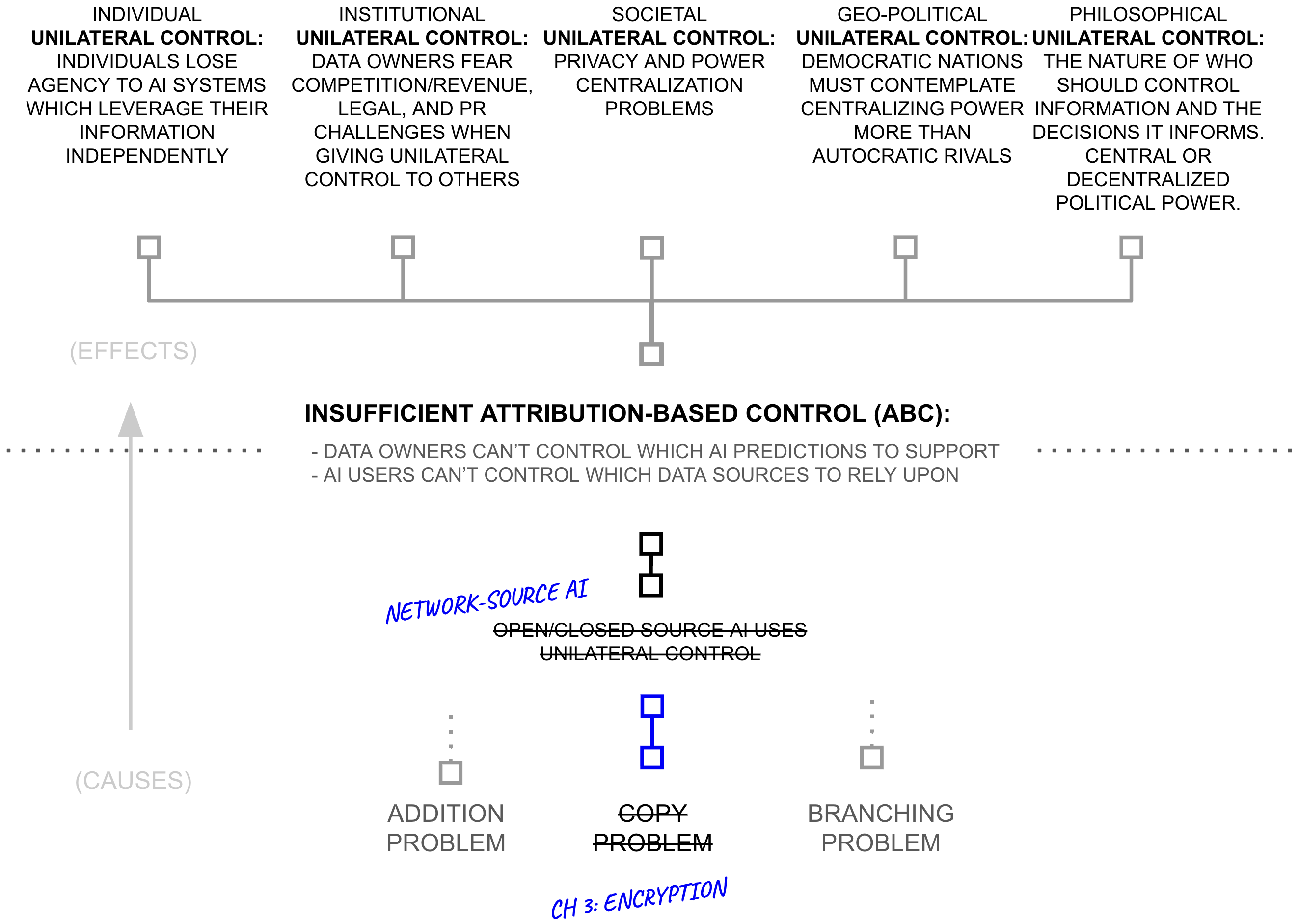
This chapter previously described how open and closed-source AI are the two governance paradigms for AI systems, but that neither offered sufficient control due to the copy problem. In the previous section, this chapter described structured transparency, and its applications in averting the copy problem. Consequently, structured transparency yields a control paradigm wherein an AI model is neither closed nor open, but is instead distributed across a network: network-source AI.
This shift from copied software to network-resident computation directly addresses the fundamental limitations of both open and closed source paradigms. Where closed source asks data contributors to trust corporate guardians and open source requires them to surrender control entirely, network-source AI enables ABC through cryptographic guarantees.
Notably, this change addresses some of the thorny issues underlying the debate between open and closed source AI, for example, copyright and attribution. Rather than consolidating control under corporations or eliminating it entirely, network-source AI provides creators with ongoing cryptographic control over how their work informs AI outputs. Intelligence budgets and attribution mechanisms become technically enforced rather than merely promised.
Safety and misuse prevention transform as well. Instead of relying on corporate oversight or community scrutiny, network-source AI enables data sources to cryptographically withdraw support if their information enables harmful outcomes. This absorbs the benefits of community oversight without the risks of single-points of failure within that community misusing AI in the process.
Even bias and representation concerns find some resolution. Rather than centralizing decisions about representation or allowing unrestricted modification, network-source AI gives communities ongoing cryptographic control over how their perspectives inform AI decisions. Attribution and intelligence budgets make representation a legible, tunable parameter through technical means.
This resolves the choice between open and closed source AI by creating a third option: AI systems that are simultaneously transparent (through verification) and controlled (through cryptography). The key insight is that by preventing copying through structured transparency’s guarantees, we can maintain both visibility into how systems operate and precise control over how information is used.
This yields something fundamentally different from both open and closed source AI. It’s not software that must be copied to be used, but rather a network service with cryptographic guarantees about how it operates. This enables true attribution-based control while maintaining the transparency needed for safety and accountability.
First Hypothesis: Collective Control facilitates ABC
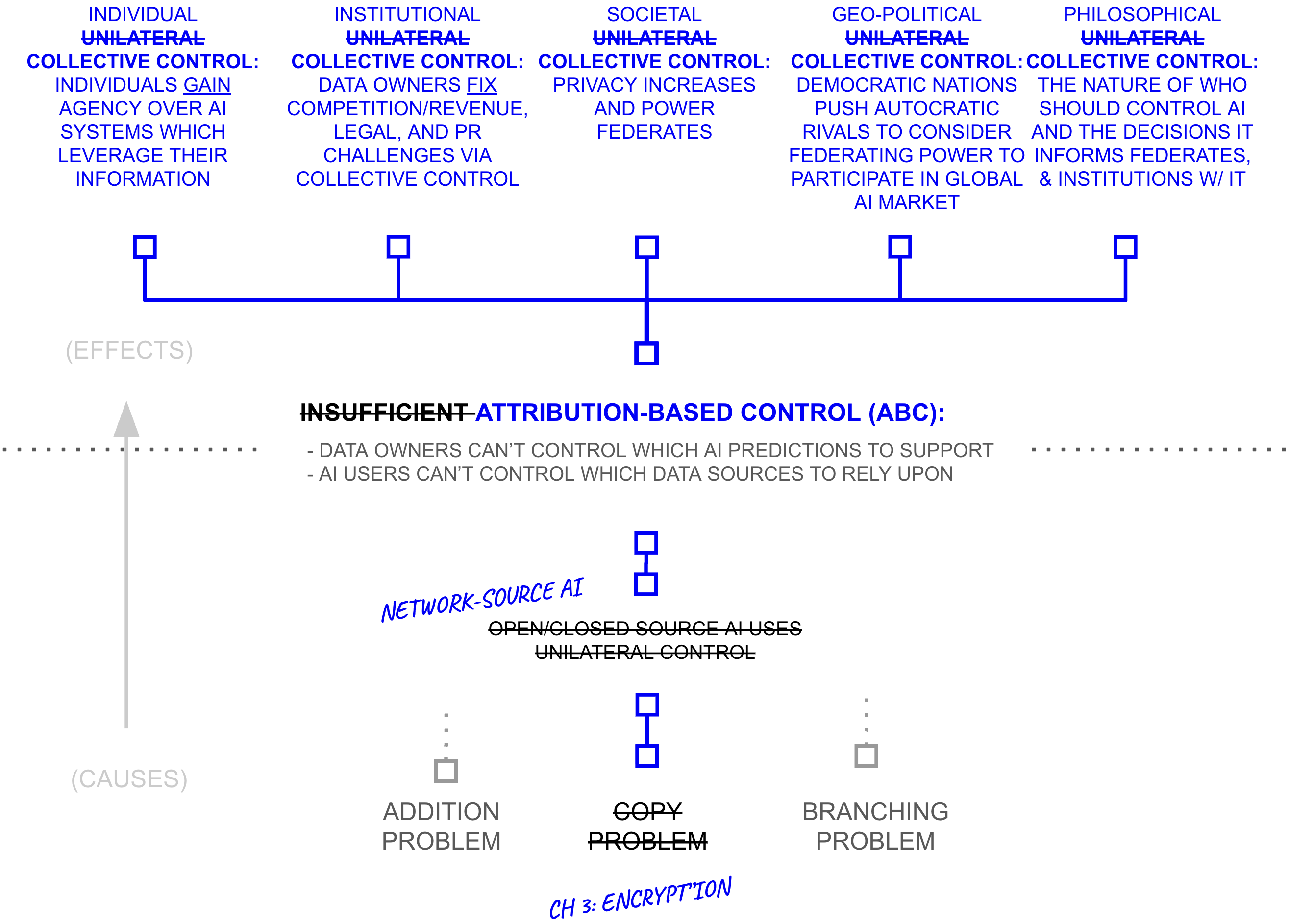
Taken together, as unilateral control averted attribution-based control, collective control over how disparate data and model resources come together to create an AI prediction facilitates attribution-based control. And by combining deep voting with the suite of encryption techniques necessary for structured transparency, collective control in AI systems becomes possible.
However, a fundamental challenge remains. While attribution-based control enables AI users to select which sources inform their predictions, it introduces a trust evaluation problem at scale. In a system with billions of potential sources, individual users cannot practically evaluate trustworthiness of each contributor. Without mechanisms for scalable trust evaluation, users may default to relying on centralized intermediaries, undermining the distributed control that network-source AI can enable.
References
- (2020). Beyond Privacy Trade-offs with Structured Transparency. arXiv:2012.08347.
- (2023). Organizational Factors in Clinical Data Sharing for Artificial Intelligence in Health Care. JAMA Network Open, 6, e2348422.
- (2020). Secure, privacy-preserving and federated machine learning in medical imaging. Nature Machine Intelligence, 2:305– 311, 6.
- (2009). Fully homomorphic encryption using ideal lattices. STOC 2009, 169–178.
- (2016). Intel SGX Explained. IACR Cryptology ePrint Archive, 2016/086.
- (1982). Protocols for Secure Computations. FOCS 1982, 160–164.
- (1987). How to play ANY mental game. STOC 1987, 218–229.
- (2014). The Algorithmic Foundations of Differential Privacy. Foundations and Trends in Theoretical Computer Science, 9(3–4), 211–407.
- (1989). The Knowledge Complexity of Interactive Proof Systems. SIAM Journal on Computing, 18(1), 186–208.
- (1988). Zero-Knowledge Proofs of Identity. Journal of Cryptology, 1(2), 77–94.
- (2014). Certificate Transparency. RFC 6962.
- (2020). Signal: Private Group System. Signal Foundation.
- (1979). How to Share a Secret. Communications of the ACM, 22(11), 612–613.
- (2017). Democracy of Sound: Music Piracy and the Remaking of American Copyright. Oxford University Press.
- (2020). Combating Disinformation in a Social Media Age. WIREs Data Mining and Knowledge Discovery, 10(6), e1385.
- (2015). Data and Goliath: The Hidden Battles to Collect Your Data and Control Your World. W.W. Norton & Company.
- (2020). Privacy Is Power: Why and How You Should Take Back Control of Your Data. Transworld Digital.
- What drives academic data sharing? PLOS ONE, 10:e0118053, 02.
- Sharing neuron data: carrots, sticks, and digital records. PLoS Biol, 13(10):e1002275.
- From data silos to data mesh: a case study in financial data architecture. In International Conference on Database and Expert Systems Applications, pages 3–20. Springer.
- Coordinating government silos: challenges and opportunities. Global Public Policy and Governance, 1(1):20–38.
- Compelling responses to NTIA’s AI open model weights RFC. Open Source Initiative Blog, April. Accessed: 2025-11-04.
- NTIA AI open model weights RFC. Request for Comment, Docket No. NTIA-2023-0009, February. Comment period closed March 27, 2024.
- Ai startup anthropic agrees to pay $1.5bn to settle book piracy lawsuit. The Guardian, September. Settlement could be pivotal after authors claimed company took pirated copies of their work to train chatbots.
- The open source ai definition – 1.0. Accessed: 2025-11-04.
- Open source, open risks: The growing dangers of unregulated generative ai. IBM Think.
- The zuckerberg-lecun ai paradox: A tale of two visions. Medium, August. Accessed: 2025-11-04.
- The ethics of advanced ai assistants.
- Reducing bias in AI models through open source. Red Hat Blog, September. Accessed: 2025-11-04.
- The Black Box Society. Harvard University Press.
- (2015). Data sharing: Why it doesn’t happen. Nature Jobs.
- The times sues openai and microsoft over a.i. use of copyrighted work. The New York Times, December.
- The protection of classified information: The legal framework. Technical report.
- Communication efficient learning of deep networks from decentralized data. In Artificial Intelligence and Statistics, pages 1273–1282. PMLR.
- From input private to universally composable secure multi-party computation primitives. In 2014 IEEE 27th Computer Security Foundations Symposium, pages 184–198. IEEE.
- UN Handbook on Privacy-Preserving Computation Techniques.
- Functional encryption: Definitions and challenges. In Theory of Cryptography Conference, pages 253–273. Springer.
- Calibrating noise to sensitivity in private data analysis. In Theory of Cryptography: Third Theory of Cryptography Conference, TCC 2006, New York, NY, USA, March 4-7, 2006. Proceedings 3, pages 265–284. Springer.
- The sovrin network and zero knowledge proofs. sovrin.org.
- Self-sovereign identity in a globalized world: Credentialsbased identity systems as a driver for economic inclusion. Frontiers in Blockchain, 2, 01.
- Secure outsourced computation. In International Conference on Cryptology in Africa, pages 1–20. Springer.
- Security without identification: Transaction systems to make big brother obsolete. Commun. ACM, 28(10):1030–1044, October
- Personhood credentials: Artificial intelligence and the value of privacy-preserving tools to distinguish who is real online.